Every water feature I build — rain curtain, reflection pool, Corten wall, faux stone, mesh panel — has one thing in common. The basin is always 304 stainless steel. No exceptions.
That’s not a marketing line. It’s a decision I arrived at the hard way, through years of working with other materials and watching what happens to them over time. This post explains why, what the alternatives look like in practice, and what you should be asking any fabricator before you sign off on a basin spec.
How I got here — the short version
I didn’t start out building stainless basins. My first water features used polypropylene rectangular tanks — the same material used in RV gray water tanks. There are companies that manufacture these in various rectangular sizes and they seemed like a practical solution early on. They hold water, they don’t rust, and they’re relatively inexpensive.
The problems showed up fast. First, the tanks only came in fixed sizes. When a client wanted a custom dimension — wider, narrower, longer — I had no good answer. I was limited to whatever the tank manufacturer offered, which meant I was limiting my product line to fit a tank catalog instead of building what the project actually needed.
The second problem was stability. When you set a large metal water feature on top of a polypropylene tank, you’re putting significant weight on a material that has some flex to it. It moves. Not dramatically, but enough that I didn’t feel good about it long term. A water feature is a permanent landscape installation. It needs to sit on something that’s as solid as it looks.
Before that, going back even further, I was building with mild steel — 16 gauge — and simply letting it rust as part of the aesthetic. That worked for a while. Then I started seeing what the water was doing to the steel over time. Mild steel doesn’t develop a protective patina the way Corten does. It just keeps rusting. Eventually I had material that had rusted so completely through that you could push your finger right through what had been a solid piece of 16 gauge steel. It had become paper thin. Those were features that should have lasted decades.
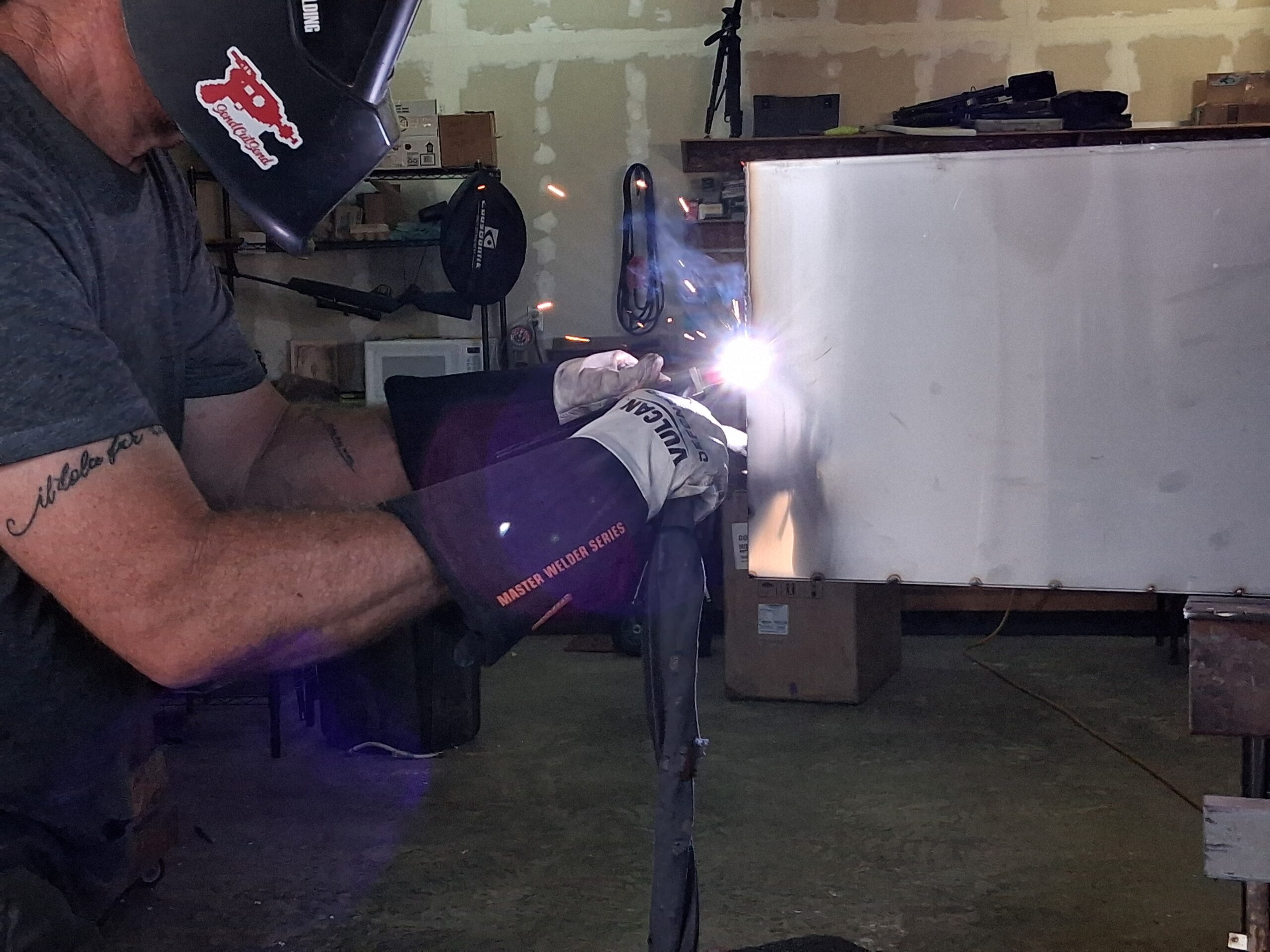
That’s when I started learning to TIG weld stainless. I had my first TIG machine sitting in the box, unopened, for almost a year. I was intimidated by the process. Once I finally dug in and learned it, it opened up everything. Custom dimensions, material that actually holds up to water long term, and the ability to build exactly what a project requires rather than working around the limitations of what I could buy off the shelf.
Why the basin is the most critical component in any water feature
The exterior of a water feature — whether that’s Corten, brushed stainless, powder coat, or faux stone — gets wet and dries out. There’s a cycle. Even on a rain curtain running during the day, the exterior surfaces have periods where they’re not fully submerged.
The basin doesn’t get that break. It holds water continuously. It’s the component that is permanently, constantly in contact with water — and with whatever is in that water. Minerals, chemicals, debris, algae. Everything that comes through the system ends up sitting in the basin at some point.
That means the basin has to be built from a material that can handle permanent submersion without degrading. And when you look at what’s available at a reasonable cost, 304 stainless is the clear answer for the vast majority of installations.
The basin is the one component you cannot easily access or replace once a feature is installed. Everything else — pumps, nozzles, fittings, even exterior panels — can be serviced. A failing basin means pulling the entire feature. Get it right the first time.
The material options — what works and what doesn’t
Here’s an honest rundown of basin materials I’ve either used, been asked about, or seen other fabricators use:
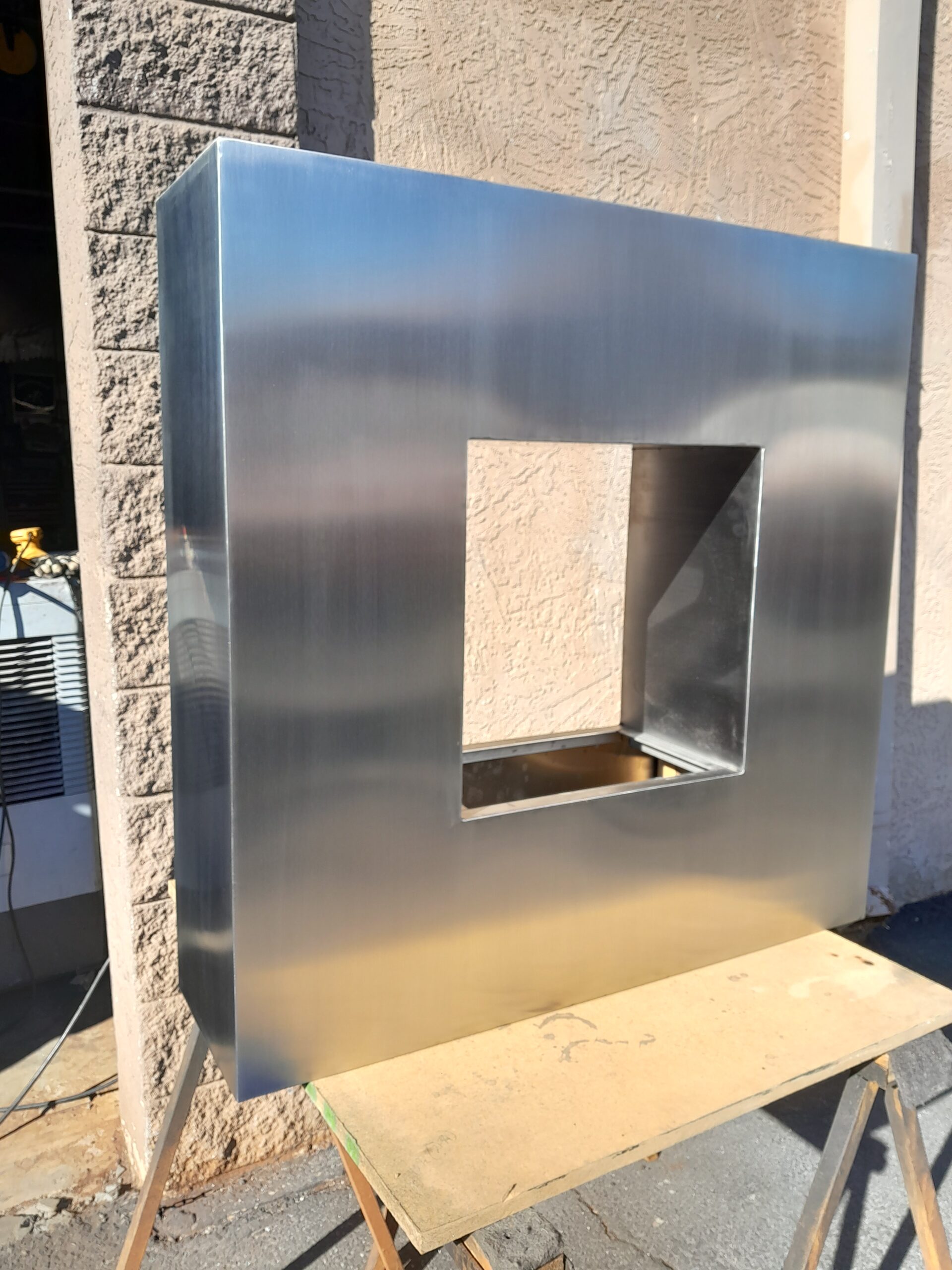
304 stainless steel ✓ Correct choice — welds clean, holds dimension, resists corrosion in standard water conditions, available everywhere, cost-effective for the application.
316 stainless steel ✓ Better for harsh environments — worth the additional cost for poolside or coastal installations where chloride exposure is high. Overkill for most standard residential applications.
Mild steel ✗ Wrong choice — rusts through completely with permanent water exposure. I’ve seen 16 gauge mild steel reduced to paper-thin material you could push a finger through. No protective patina, no stopping point. Do not use.
Corten steel ✗ Wrong choice — Corten’s weathering properties depend on intermittent wet-dry cycles to form a stable patina. Permanent submersion doesn’t allow that cycle. I’ve spoken with Corten manufacturers directly — constant submersion is not an appropriate use of the material. Other fabricators are using it as a basin. I wouldn’t.
Polypropylene tanks ⚠ Limited use only — holds water and doesn’t corrode, but fixed sizes limit custom work and the material has flex under heavy loads. Usable for very small, lightweight features on a tight budget. Not appropriate for custom architectural installations.
Galvanized steel tanks ⚠ Last resort only — horse tanks and agricultural galvanized tanks get requested occasionally by clients on a budget. I’ve accommodated this when a client specifically requests it, but only with a clear understanding that I cannot guarantee the product or the installation. Galvanized steel and stainless components in contact in a wet environment creates a galvanic corrosion problem — two dissimilar metals accelerate each other’s degradation. It’s not a setup I recommend.
Fiberglass / composite ⚠ Depends on application — can work for certain low-profile applications but adds complexity for custom sizing and doesn’t integrate as cleanly with metal fabrication work.
Why 304 and not 316 as the universal standard?
If you’ve read my previous post on 304 vs. 316 stainless, you know I recommend 316 for poolside and coastal environments. So why is my basin standard 304 rather than 316 across the board?
A few reasons. First, 304 is an industry standard that’s stocked at most suppliers and easily ordered everywhere. 316 requires more lead time in some markets and carries a meaningful cost premium — roughly 20-30% more for material. For a basin in a standard residential or commercial non-poolside installation, that additional cost doesn’t buy you a meaningful improvement in performance.
Second, the basin in most installations is not the component being attacked by chlorides or salt air. The exterior surfaces are — and those are Corten or stainless panels that see direct environmental exposure. The basin is enclosed, shaded, and its primary exposure is to whatever water the system is recirculating. In a standard municipal water system without aggressive chemistry, 304 handles that application extremely well.
The exception is exactly what I described in the 304 vs. 316 post — a poolside commercial installation where highly chlorinated water is being recirculated through the feature. In that case, 316 for the basin is the right call and worth the additional cost.
Default to 304 for most basins. Upgrade to 316 when the water source is a commercial pool, the installation is coastal, or the client’s water chemistry is aggressive. The decision process is the same as for the exterior finish — match the material to the environment.
The galvanic corrosion problem with mixed metals
This comes up most often when a client wants to use a galvanized horse tank or agricultural tank as a basin — usually for cost reasons. The concept seems practical: tanks are cheap, they hold water, done.
The problem is what happens when you connect stainless steel components — fittings, frameworks, pump hardware — to galvanized steel in a permanently wet environment. Galvanic corrosion occurs when two dissimilar metals are in electrical contact in the presence of an electrolyte, which water absolutely is. The less noble metal in the pairing corrodes faster than it would on its own. In a galvanized-and-stainless pairing, the galvanized steel is the one that loses.
I’ve done galvanized tank installations when clients have specifically requested them with full awareness of the limitations. I’m transparent about it: I’m not going to guarantee anything about a product I didn’t fabricate, and the mixed-metal situation is a known liability. For a client on a tight budget who understands those tradeoffs, it’s a conversation worth having. As a fabricator recommendation? It’s not something I’d advise.
⚠ If a fabricator quotes you a water feature with a Corten or mild steel basin and doesn’t mention this as a limitation, that’s a red flag. Ask specifically what the basin material is and why. A fabricator who has thought this through will have a clear answer.
What to ask any fabricator before you approve a basin spec
Whether you’re speccing a feature through us or working with another fabricator, these are the questions worth asking:
- What material is the basin? The answer should be stainless steel. If it’s anything else, ask why.
- What gauge is the stainless? Thinner material costs less but has less structural integrity. Know what you’re getting.
- How are the seams welded? TIG welded stainless with properly finished seams is the standard for a water-tight, long-lasting basin. Ask about the welding process.
- What’s the drain configuration? Maintenance access matters. A basin that can’t be properly drained and cleaned will cause problems over time regardless of the material.
- Is the basin sized for the feature or adapted from a stock size? Custom fabricated to fit is always better than a stock tank modified to work. The former is built for the application. The latter is a workaround.
The short version
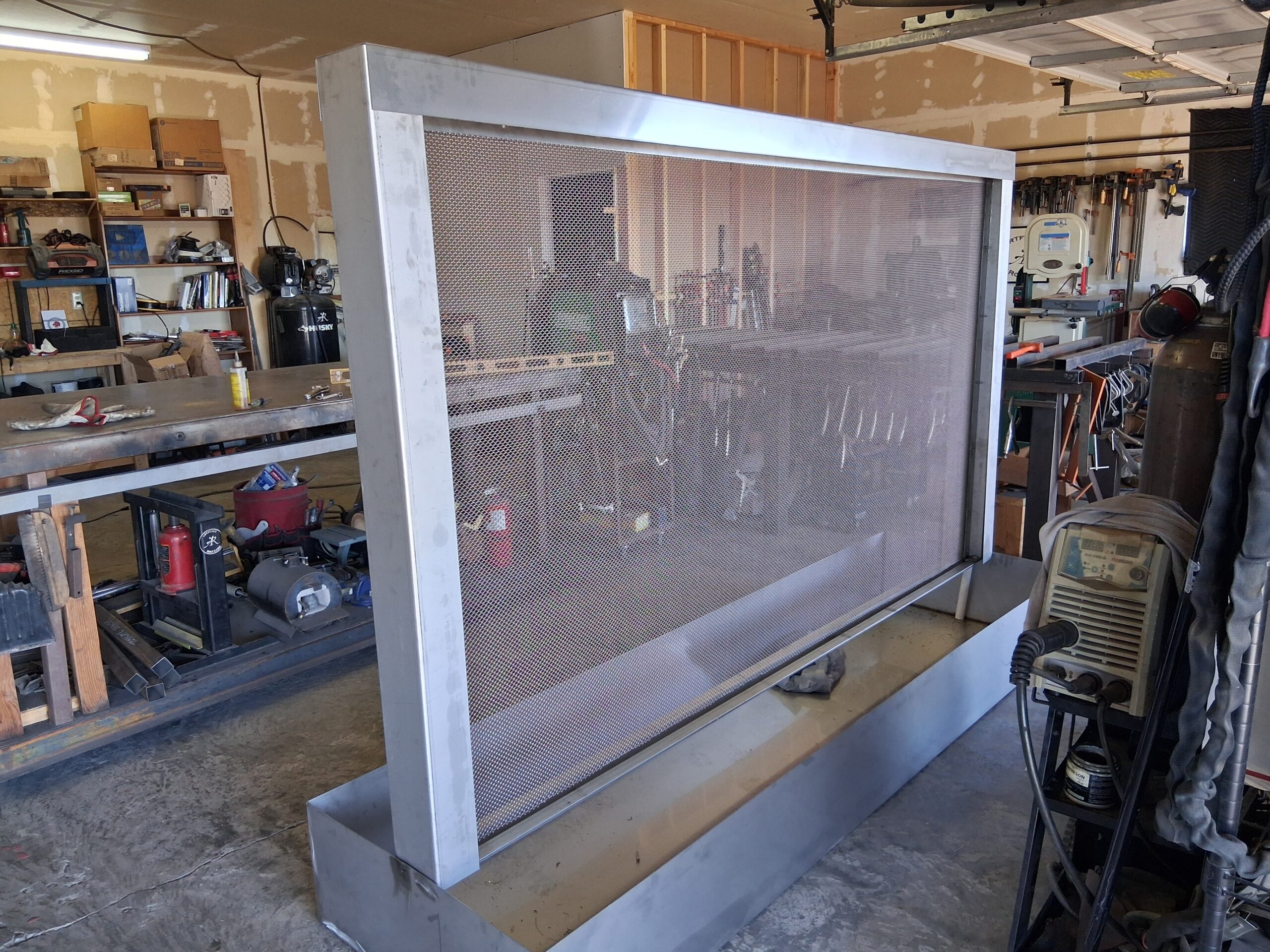
The basin is the foundation of every water feature. It’s permanently wet, it’s load-bearing, and it’s the hardest component to access or replace after installation. Building it out of anything less than 304 stainless — for most applications — is a decision that saves money upfront and costs significantly more later.
I learned that lesson through mild steel that rusted paper thin and polypropylene tanks that limited what I could build. The TIG welder sitting in my shop for a year, unopened, was the thing standing between me and doing it right. Once I learned to use it, I never went back.
Every basin I ship is 304 stainless, TIG welded, built to the exact dimensions of the feature it’s going into. That’s not a premium option. It’s the standard.
Questions about basin specs, materials, or what’s right for a specific installation? Happy to talk through it before anything gets built.
Reach out at fountainmetalworks.com or call (928) 274-2697.
Fountain Metalworks fabricates custom rain curtains, reflection pools, stainless basins, and Corten water features for landscape architects and contractors nationwide. Built in Tucson, Arizona. Shippe