Of all the custom water features we build, the reflection pool generates more interest from landscape architects and luxury residential designers than almost anything else. It is clean, modern, and when done right, it stops people in their tracks — creating a still, mirror-like surface of water that sits flush with the surrounding landscape, hiding all plumbing and mechanics to reveal just water.
It’s also one of the more engineered products in our lineup. There’s more going on inside a reflection pool than the finished product suggests. This post breaks down exactly how builders construct them, what creates the effect, and everything contractors or designers must know before speccing one.
What a reflection pool water feature actually is
The reflection pool takes its inspiration from the infinity pool concept — specifically the visual effect of water appearing to extend to the horizon with no visible edge. In a traditional infinity pool, water fills the pool until it overflows one edge, drops into a catch basin below, and recirculates back into the pool. The result is water that appears to have no boundary on one side.
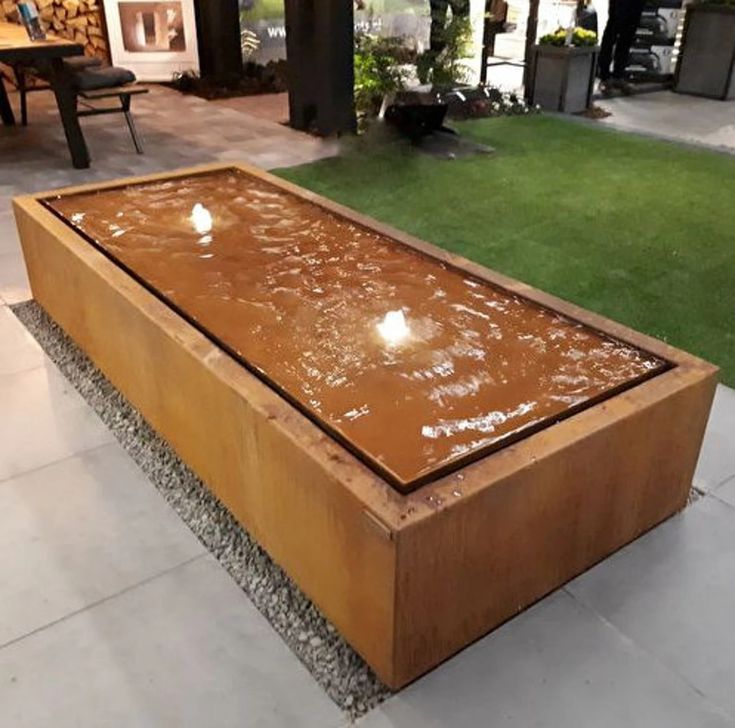
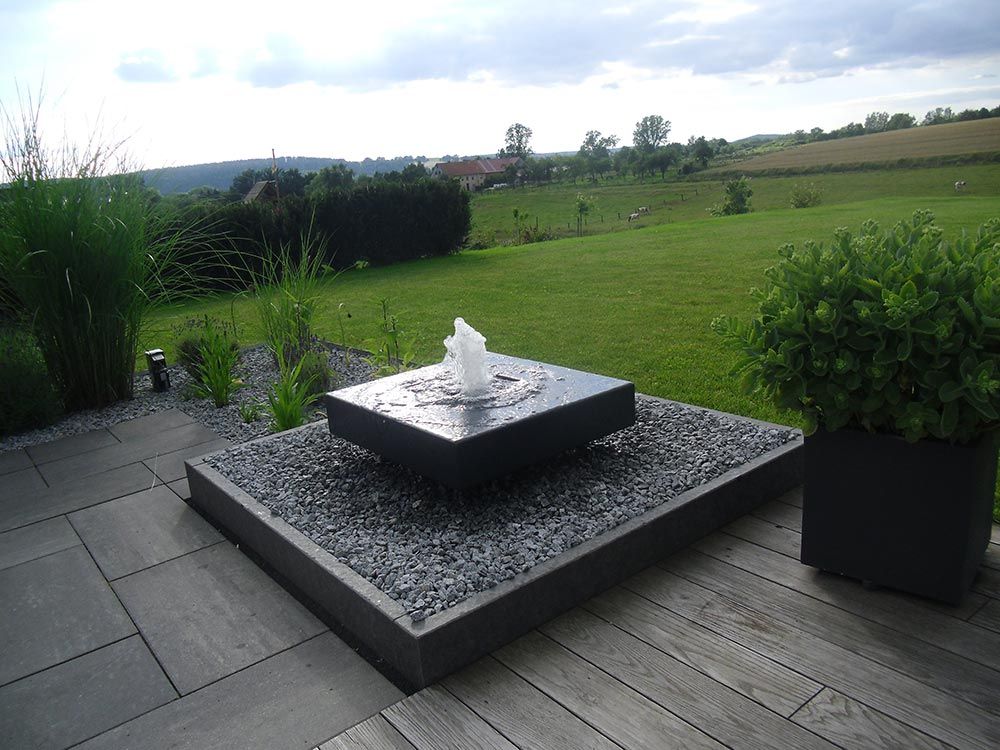
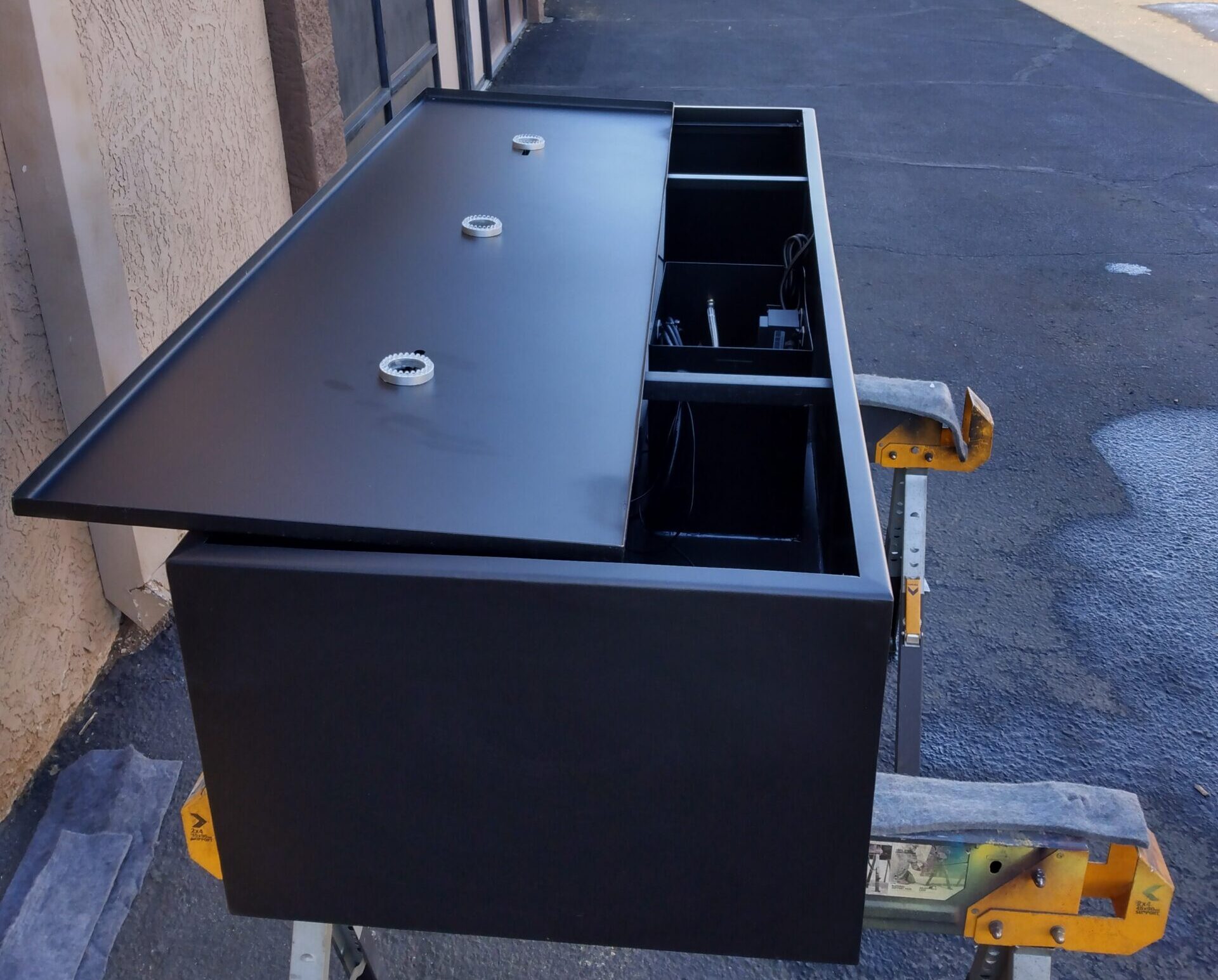
A reflection pool water feature works on the same principle, scaled down and self-contained. Inside the outer stainless steel basin, there’s an inner tray that sits approximately half an inch below the top edge of the basin. Water fills the tray — only about one inch deep — and continuously overflows the tray’s edges, drops into the space between the tray and the basin walls, before the pump system recirculates it back up.
From above, you see a basin filled to the brim with still, reflective water. The tray edge is invisible. The overflow is invisible. The plumbing is invisible. It simply looks like a perfect, calm pool of water — which is exactly the point.
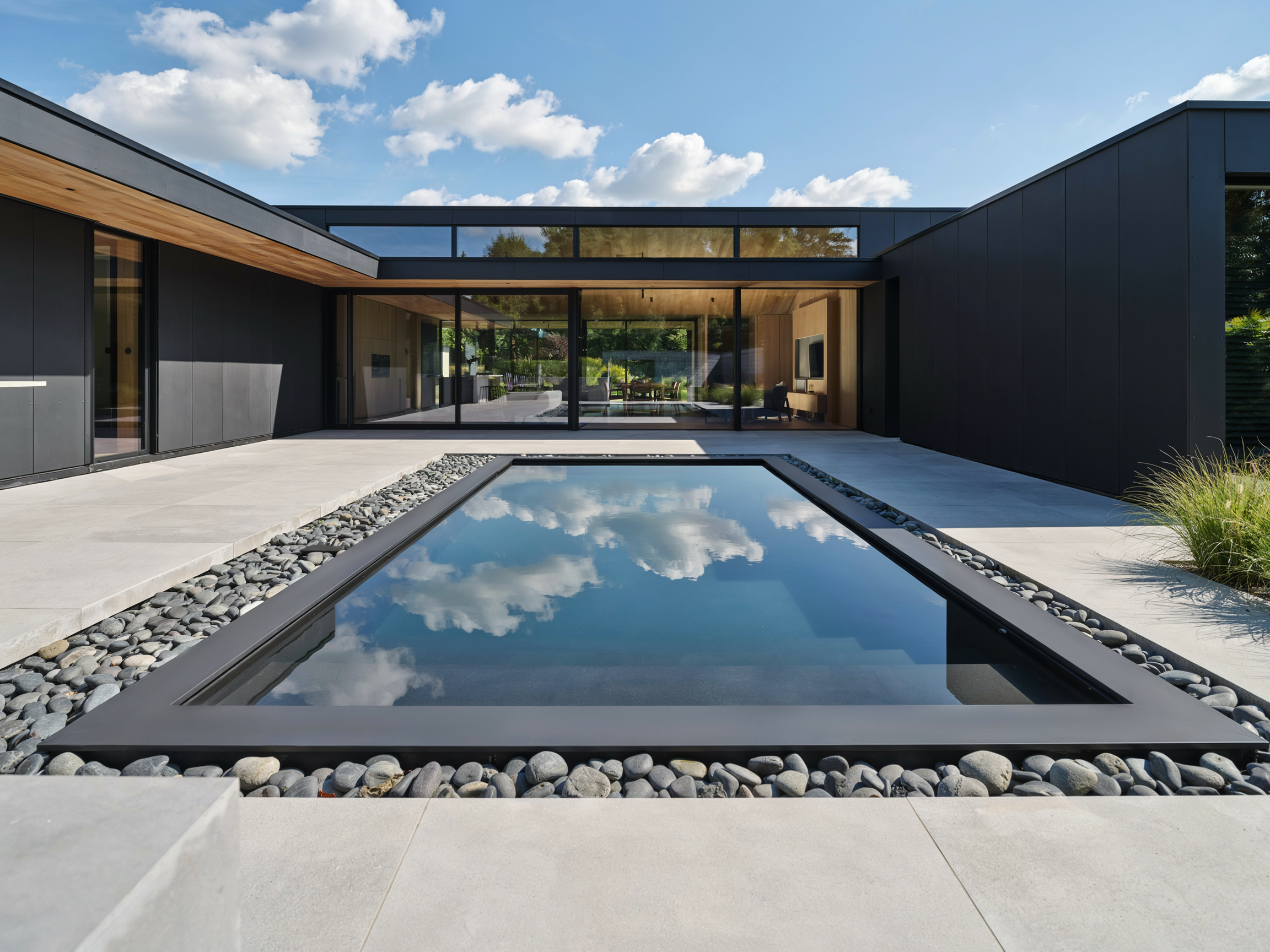
The half-inch gap between the tray and the basin top edge is the key to the illusion. Position the tray any lower and you can see the gap — the effect is lost. Position it flush and the water can’t overflow properly. That half-inch is the spec that makes the whole thing work.
Standard dimensions and what we can customize
Every reflection pool we build is custom, but we work from a set of standard dimensions that have proven to work well across a wide range of installations:
Standard height: 16 inches (minimum 12 inches)
Standard width: 36 inches (range: 15 inches to 60 inches)
Length: Fully custom — smallest we’ve built is 4 feet, largest is 18 feet
Height and width have practical limits — too shallow and the basin doesn’t have enough volume for proper recirculation; too wide and the tray needs additional structural support. Length is essentially unlimited for our fabrication process, though very long features may ship in sections depending on freight constraints.
The most common configuration for luxury residential is a 36-inch wide by 8 to 12-foot long feature, either at standard 16-inch height above grade or set flush to the ground so the water surface appears to sit at grade level. Both installation methods work with the same product — it’s a site decision, not a fabrication decision.
The vault system — why this matters for commercial and public installations
One of the design features that sets our reflection pools apart — particularly for commercial, hospitality, and public space applications — is the integrated utility vault.
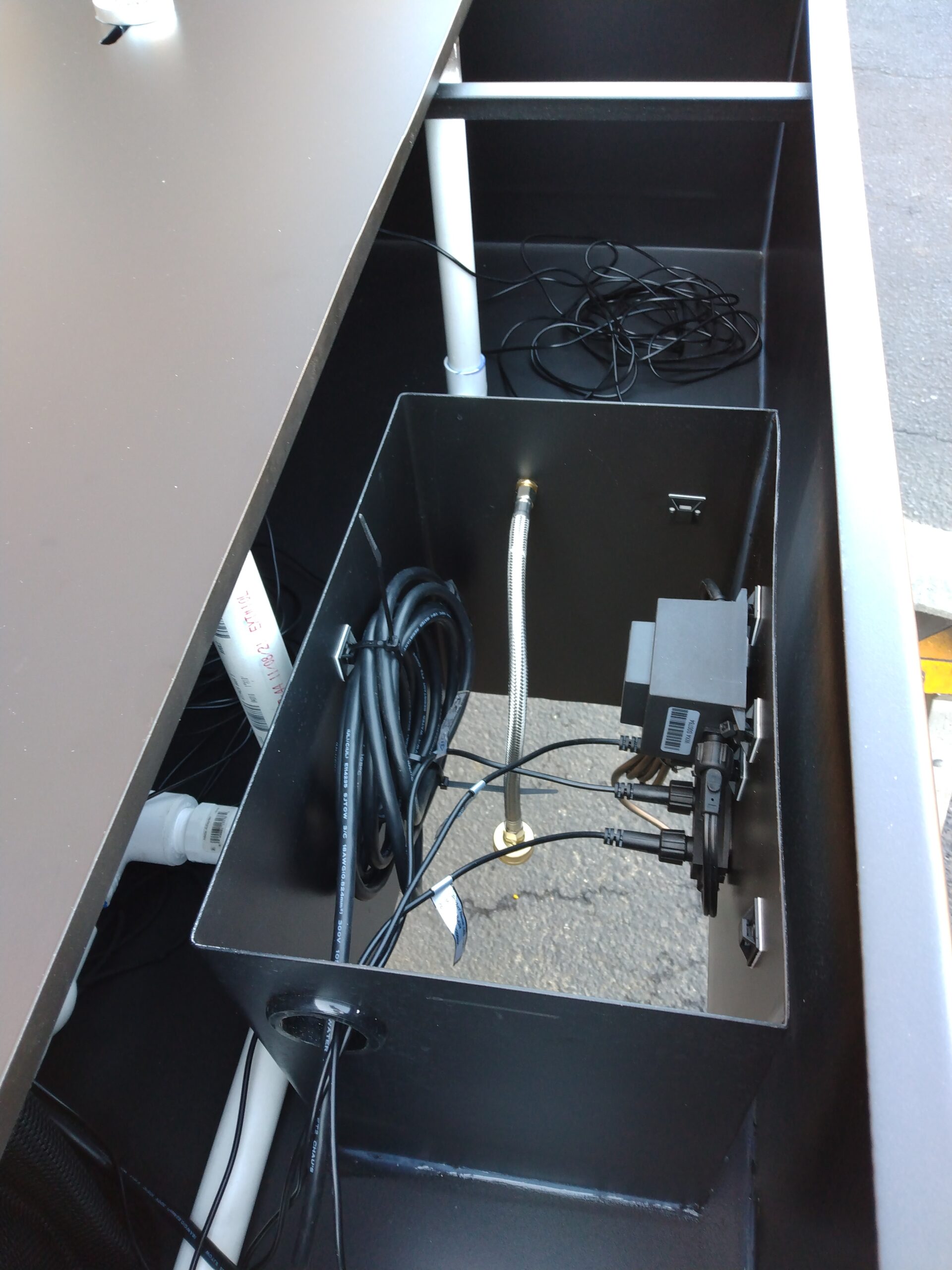
The vault is a TIG-welded stainless steel enclosure built into the basin floor. It’s essentially a dry box within the wet basin. The contractor stubs up electrical conduit and water supply through the ground into the vault before setting the feature in place. All utility connections — pump power, water supply, any lighting wiring — live inside the vault, completely isolated from the water in the basin.
The vault has a cap that seals it off from the water above. When the tray overflows and water circulates through the basin, none of it enters the vault. The utilities stay dry, protected, and completely inaccessible from above.
For public spaces, hospitality properties, and commercial installations, the vault is a significant advantage. This design hides utilities, protects them from tampering or accidental damage, and meets code requirements for concealed electrical in water feature applications. Nobody can access the pump or wiring from above — it requires removing the tray to get to the vault, which isn’t something a passerby can do.
From an installation standpoint, the vault also simplifies the contractor’s work. Stub up the conduit and water line to the vault location before the feature arrives, set the feature in place, make the connections inside the vault, replace the cap, set the tray, and the utilities are done. Clean, organized, and invisible.
Bubblers and LED lighting — standard and optional elements
Every reflection pool we build includes bubblers. The number varies by size — a shorter feature might have two or three, a longer feature might have five or six — but the count isn’t fixed. If a client wants additional bubblers for more surface movement, that’s not a problem. Fewer bubblers for a calmer surface is equally straightforward.
The bubblers create gentle upwelling movement at the water surface. On a calm day with no wind, the reflection pool surface is nearly mirror-flat between the bubblers. The bubblers introduce just enough movement to catch light and create visual interest without disturbing the overall reflection effect.
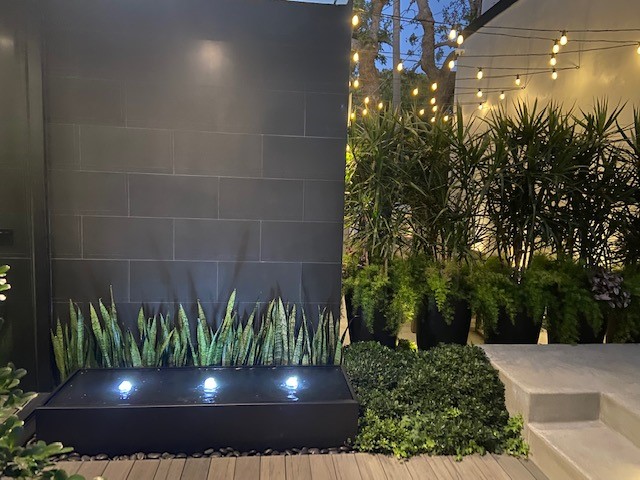
LED ring lights are an available option that we’d honestly recommend to most clients. Each ring light sits around a bubbler, illuminating the water in a 360-degree circle at the surface. At night, the effect is striking — the bubblers glow from below, the water surface catches the light, and the feature reads as a dramatically different element than it does during the day. It’s the kind of detail that justifies the price point on a luxury residential installation.
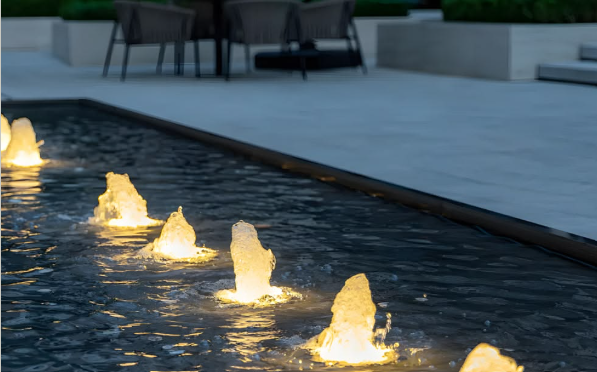
LED ring lights are an option, not standard. But if a client is on the fence, show them a nighttime photo. The daytime feature is elegant. The nighttime feature with LED lighting is exceptional. Most clients add the lights once they see what it looks like.
Safety — why reflection pools work in public and high-traffic spaces
A question that comes up with any water feature in a public or semi-public space is safety — particularly when children or pets are involved. Sixteen inches of water in an open basin is a legitimate concern.
The reflection pool design addresses this in a way that most water features don’t. The tray — which is the visible water surface — sits on stainless steel supports inside the basin. The water depth on the tray is only about one inch. If a child climbs onto the feature, they’re standing on a supported stainless steel tray with one inch of water on it. They’re not falling into sixteen inches of water. They’re getting their shoes wet.
The basin below the tray holds the recirculating water volume, but it’s not accessible from above without removing the tray. In a properly installed feature, that’s not something that happens accidentally.
This safety characteristic makes the reflection pool one of the better water feature options for HOA common areas, hotel courtyards, restaurant patios, and other spaces where the public has access and liability is a consideration.
Design variations worth knowing about
The standard reflection pool is a single rectangular basin with a single tray. But the design lends itself to a number of variations that landscape architects find useful:
- Above grade installation: the basin sits on the surface, typically on a hardscape pad. The 16-inch height creates a visual anchor and a casual seating edge — people naturally sit on the rim.
- Flush to grade installation: the basin is set into the ground so the water surface appears to sit at or just above grade. Creates a dramatically different visual — the water appears to emerge from the ground rather than sitting in a container.
- Partial burial: the basin can be set at any depth between fully above grade and fully flush. Common on sloped sites where grade transitions are part of the design.
- Center bench variation: a stainless steel bench can be fabricated to sit across the center of the reflection pool, with water on both sides. Creates a seating element within the feature itself — popular for meditation gardens and contemplative outdoor spaces.
- Cascading multi-tier: two or more reflection pools at different heights, with one overflowing into the next. The overflow becomes a visible design element — a thin sheet of water dropping from one pool surface to the next. Requires more site planning and plumbing but creates a significantly more complex visual effect.
- Custom dimensions: length, width, and height are all adjustable. We’ve built features as narrow as 15 inches for tight courtyard spaces and as long as 18 feet for large-scale residential installations.
Installation overview — what contractors need to know
Reflection pools are designed to install simply. The basic process:
- Set the feature in the desired location — above grade, partially buried, or flush to grade depending on the design intent.
- Stub up electrical conduit and water supply to the vault location before setting the feature if utilities are being run from below grade.
- Remove the tray to access the vault. Make electrical and water connections inside the vault. Replace the vault cap.
- Reposition the tray, routing plumbing lines through the tray openings. Reconnect LED lights if included.
- Fill the basin. Plug in the pump. The feature starts.
The tray removal and reinstallation step is the one area that requires care. The plumbing has to route through the tray correctly, and the LED lights need to be repositioned around the bubblers after the tray is set. It’s not complicated, but it’s worth doing slowly the first time. We have a YouTube walkthrough that covers the setup process step by step — we’ll link that in the product listing.
One site prep note: the surface under the feature needs to be level and stable. A reflection pool that isn’t level will show it immediately — the water surface will be visibly higher on one side. Check level before setting the feature and shim if necessary.
Why landscape architects and designers keep coming back to this product
The reflection pool punches above its weight visually. It’s a relatively straightforward product to install, it doesn’t require a large footprint, and the finished result — that calm, mirror-like water surface — photographs exceptionally well and holds up in person even better.
In California and Texas luxury residential markets especially, we see consistent demand for this product. The design vocabulary of those markets — clean lines, indoor-outdoor integration, high-end hardscape materials — pairs naturally with a sleek stainless water feature that disappears into the landscape rather than competing with it.
The safety and utility concealment features make it viable for commercial and public space applications where other water features create liability or maintenance concerns. And the customization range — 15 inches wide to 60 inches wide, 4 feet to 18 feet long, above grade to flush — means it fits a wide range of site conditions without requiring design compromises.
Speccing a reflection pool for a project? We’re happy to work from your drawings, discuss custom dimensions, or talk through installation requirements before we provide a quote. Schedule a consultation today.
Reach out at fountainmetalworks.com or call (928) 274-2697.
Fountain Metalworks fabricates custom reflection pools, rain curtains, stainless basins, and Corten water features for landscape architects and contractors nationwide. Built in Tucson, Arizona. Shipped to your sit