If you’ve ever specced a stainless-steel water feature and had a client come back a year later with rust photos, this post is for you.
I get asked about stainless steel grades constantly — usually by landscape architects and contractors who are trying to make the right call for their client without overspending, or who are trying to figure out why something went wrong after the fact. So let me give you the straight answer from someone who fabricates these things for a living, not from a materials data sheet.
I’ll also share a real project that drove this lesson home for me personally — including the report I put together after flying across the country to fix a problem that nobody saw coming.
First, the basics — and why they matter for water features specifically
Both 304 and 316 are austenitic stainless steels. They look identical. They weld similarly. On paper they’re close. The difference is that 316 contains 2–3% molybdenum, which gives it significantly better resistance to chlorides — salt, pool chemicals, coastal air, and other corrosive environments.
For a kitchen backsplash or an indoor feature, that distinction barely matters. For an outdoor water feature running 24/7 in a challenging environment, it can be the difference between a 20-year feature and a call from an angry client two years in.
When 304 is the right call
I build every basin I fabricate out of 304 stainless, regardless of what the exterior finish is. For most indoor environments and standard outdoor residential installations away from the coast, 304 performs extremely well. It’s cost-effective, it’s what the majority of the industry uses, and when the water chemistry is normal and the environment is reasonable, it holds up for decades.
If your project is any of the following, 304 is the right choice — spending up to 316 isn’t going to buy you anything meaningful:
- An interior lobby or commercial space
- A residential installation away from the coast
- A feature using fresh water with standard municipal chemistry
- A water feature in a dry climate like Arizona, Nevada, or inland Texas or any inland area not subjected to a coastal climate.
When 316 is worth the conversation
Here’s where it gets important, and where I’ve seen things go sideways.
The moment chlorides enter the picture — whether that’s saltwater, coastal air, or aggressive pool chemistry — 304 starts to lose its corrosion resistance at an accelerated rate. The chromium oxide layer that makes stainless “stainless” gets attacked by chlorides in ways that 316’s molybdenum content resists significantly better.
Environments where you should be thinking seriously about 316:
- Any area within a mile or two of the ocean
- Features installed poolside — especially commercial or multi-family pools
- High-humidity coastal climates like Florida, Southern California coastal, or the Gulf Coast of Texas
- Any installation where the water source has high mineral content combined with chemical treatment
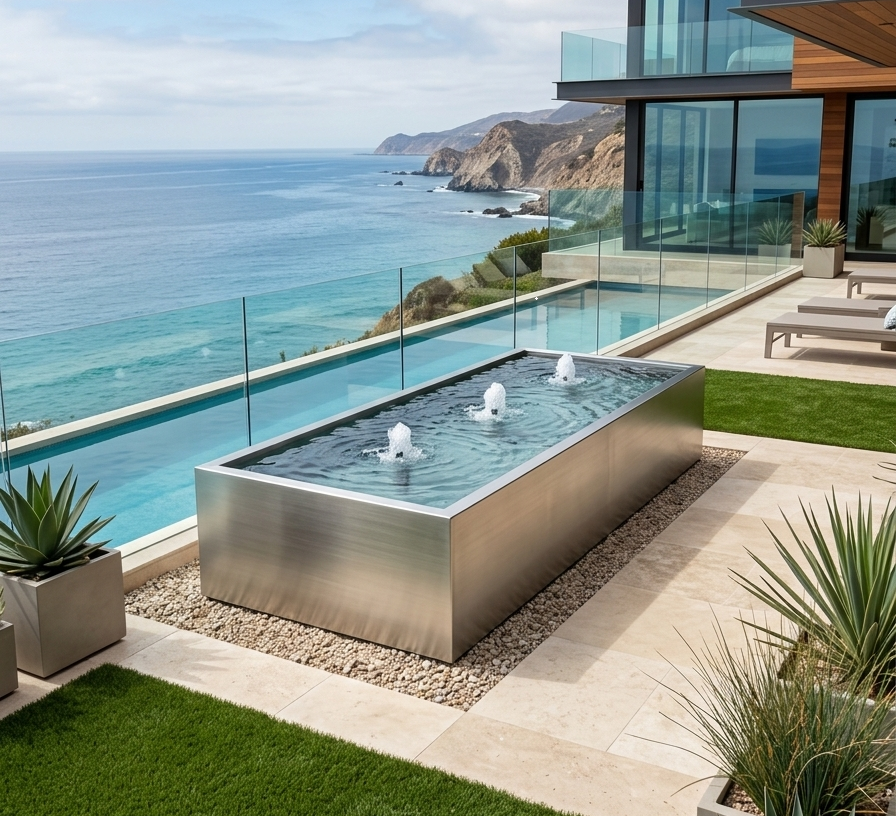
What happened in Clarksville — and why I flew out to fix it on my own dime
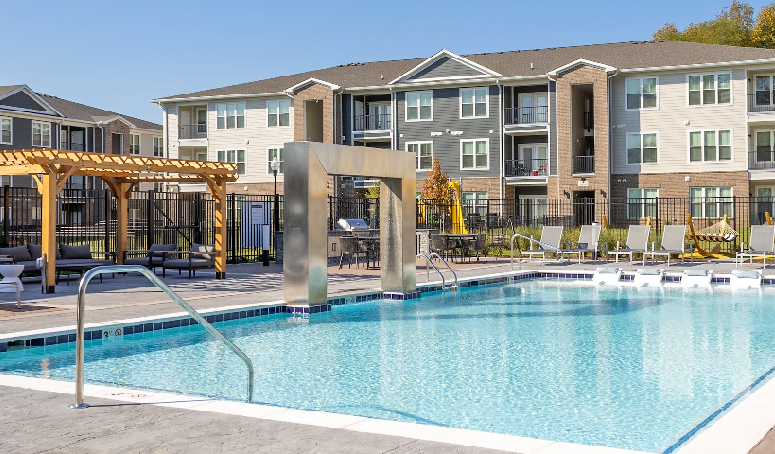
A few years back, rain curtain water features I built ended up installed at two apartment complex pools — one in Clarksville and one in Jeffersonville. Both were 304 stainless. Both were built to a spec and size I was given, and I didn’t receive the final shipping addresses or site details until the features were ready to ship. By that point, nobody had flagged that these features would be sitting poolside and circulating swimming pool water.
That’s a communication gap that happens when there are middlemen between a fabricator and a job site. It’s nobody’s fault, but it’s a real problem — and it’s one of the reasons I now ask detailed site questions before I quote anything.
About a year and a half after installation, I started getting calls. The stainless was showing rust.
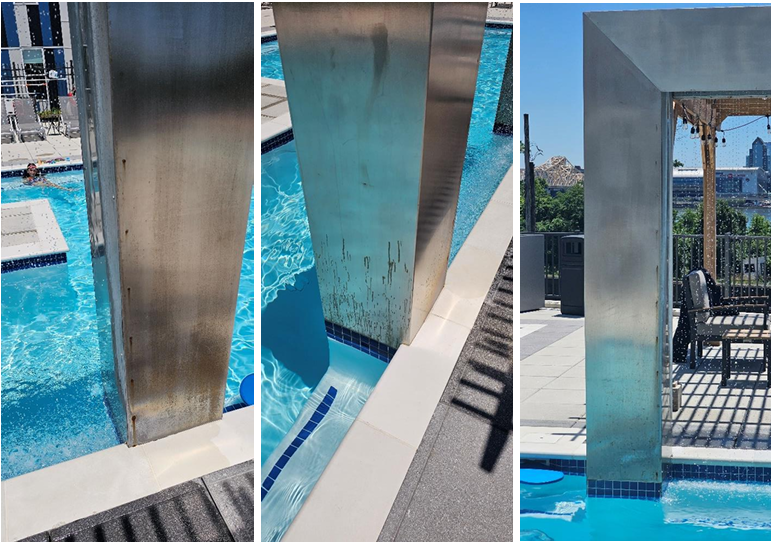
Based on the photos the client sent, I could see a few distinct issues: small round rust spots at the spot welds connecting the columns to the internal framework, long straight rust lines that looked like contamination, and darker drip patterns at the base of the columns from chemical splash. I put together an initial assessment remotely, but I knew I needed to see it in person.
I tried hiring someone local in the Clarksville area first. That didn’t work out. So I flew out from Tucson myself and showed up on a Friday morning to take care of it.
When I got there, the first thing I did was test the pool water with a standard pH test strip.
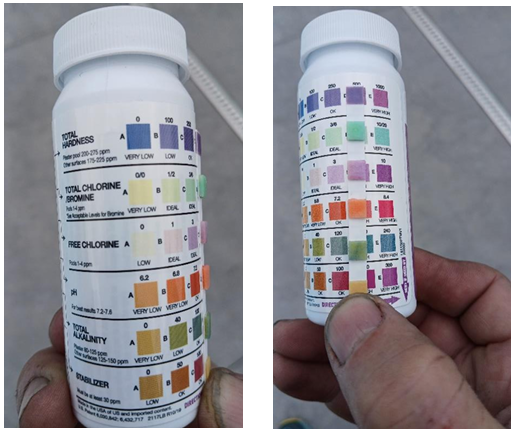
The results showed high total hardness, high free chlorine, and high chlorine/bromine levels — well outside what you’d see in a typical residential pool. I talked to the maintenance person on site, who confirmed that they add a large dose of chlorine every Monday after the heavy weekend traffic. These were high-use amenity pools serving hundreds of residents, and they were being treated accordingly.
That level of chloride concentration running through 304 stainless continuously is enough to break down the passive surface layer and initiate corrosion. That’s not a fabrication defect — that’s chemistry. The 304 was doing exactly what 304 does when it’s exposed to that environment. The problem is that 304 was the wrong spec for that environment.
The second issue was the hard water. High mineral content water running through a closed recirculating system deposits calcium on every interior surface it touches. You can see it in the photos — thick calcium buildup coating the interior panels that were in constant contact with the water. Check this blog post and learn “How To Reduce Hard Water Build-up” on your water feature.
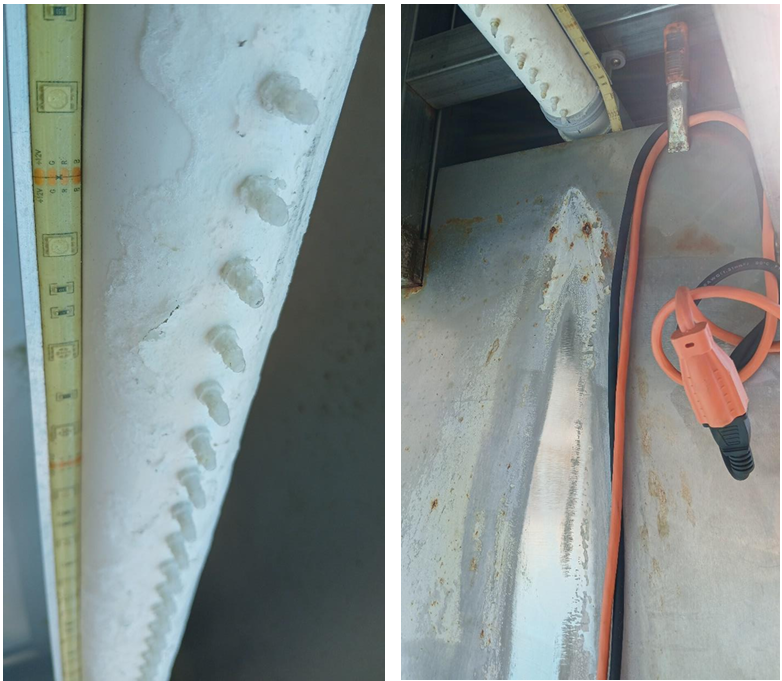
Here’s the part that made the client’s “stainless doesn’t rust” argument hard to maintain: I walked him outside and pointed to the pool’s own stainless steel handrail — the one people grab to climb out of the pool. It was showing the exact same rust pattern as the water feature.
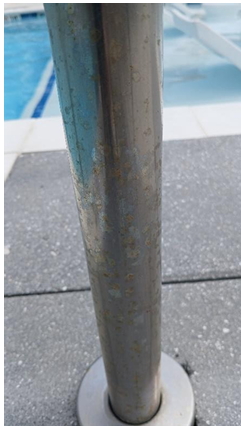
Same steel grade. Same pool water. Same result. The water feature wasn’t the problem — the water was.
I spent the day cleaning and passivating the columns using passivation gel on the spot weld areas, CLR and a sanding tool on the surface rust, and restoring the brushed stainless finish. I did the same assessment at the Jeffersonville location — same water conditions on the test strip, early-stage rust already starting at the base of one column.
Before I left, I put together a full written report documenting everything I found, what caused it, and what needed to happen to prevent it from recurring. The recommendations: rinse the features regularly with fresh water rather than pool water, clean monthly with mild soap and stainless-specific products, and install a water softener if possible. The hard water alone — separate from the chlorine — will continue to calcify any surface it contacts, and calcium buildup traps moisture against the steel, which accelerates rust even after the surface is cleaned.
What this project changed about how I work
I now ask detailed site questions before I quote any water feature. Not because I’m being difficult — because the answers change the spec and getting the spec wrong costs everyone time and money.
Before any poolside or coastal project, I want to know:
Is this a residential pool or a commercial/multi-family pool?
High-use commercial pools run significantly higher chlorine levels than a backyard pool. That changes the steel grade conversation immediately.
What’s the water source, and has anyone tested the hardness?
Hard water calcifies. In a low-use residential setting it’s slow. In a high-use commercial setting with aggressive chemistry, it happens fast and compounds every other issue.
How close is this to the ocean?
Even if the feature isn’t poolside, coastal salt air attacks stainless. 304 degrades faster in that environment than 316.
What’s the maintenance plan?
A feature that gets regular fresh-water rinses and monthly cleaning will outlast one that doesn’t, regardless of steel grade. I put this in writing now.
These questions take five minutes. They can prevent a service call, a warranty dispute, and a cross-country flight.
The short version
Use 304 for standard residential and interior installations. Use 316 for poolside commercial applications, coastal environments, and anywhere the water chemistry is aggressive. Budget roughly 20–30% more for 316 material but weigh that against the cost of remediation and a client relationship under strain.
And if you’re working with a fabricator who doesn’t ask where the feature is going and what the water conditions are — that’s worth asking about before anything gets built.
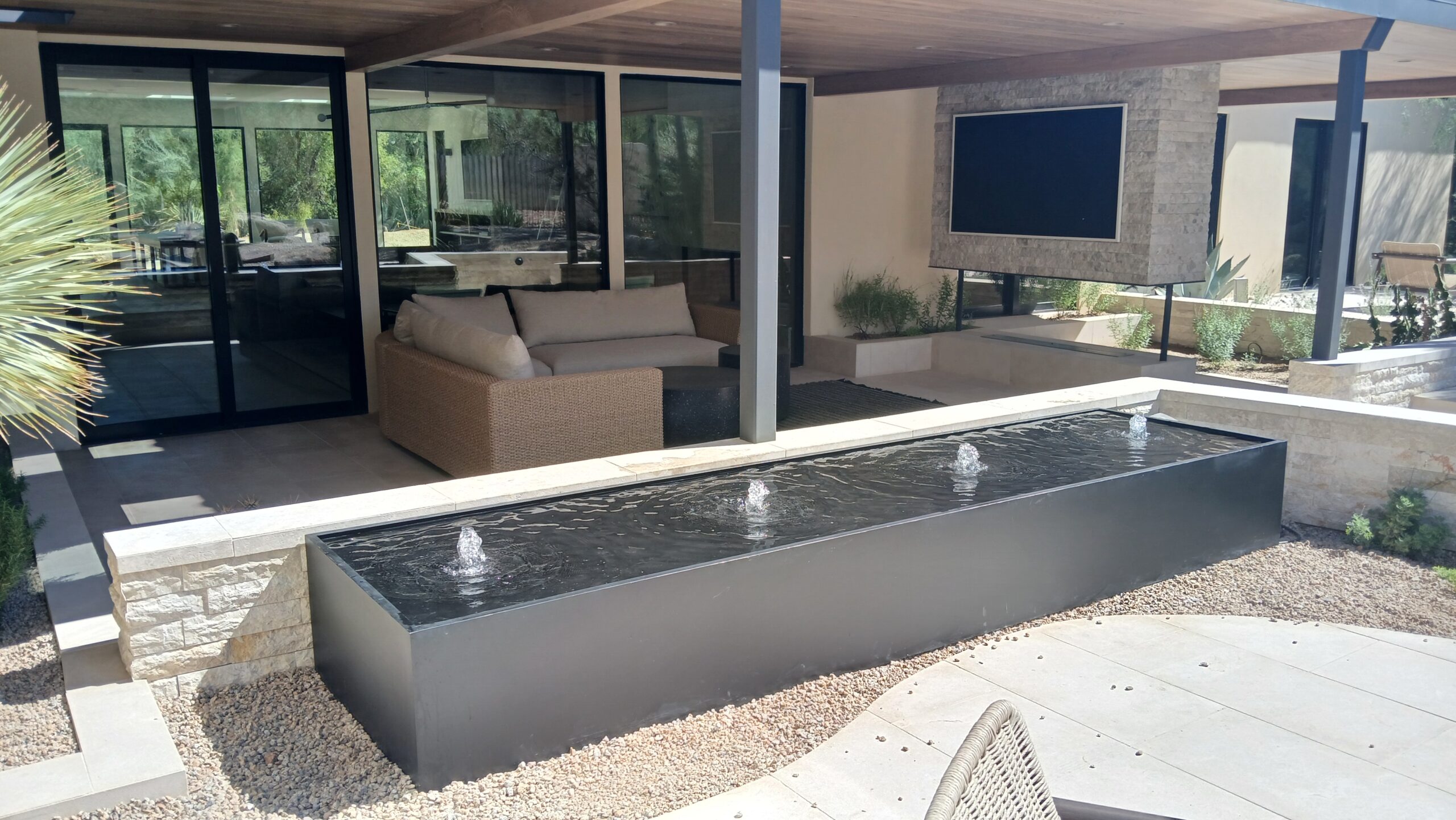
Have a project with unusual site conditions or water chemistry questions? I ask these questions on every job for exactly this reason.
Reach out at fountainmetalworks.com or call (928) 274-2697.
Fountain Metalworks fabricates custom rain curtains, reflection pools, stainless basins, and Corten water features for landscape architects and contractors nationwide. Built in Tucson, Arizona. Shipped to your site.