Let me save you some time: if you came here looking for a precise pump sizing formula, I’m going to disappoint you. Not because the math doesn’t exist — it does — but because on a custom decorative water feature, the formula only gets you partway there. The rest is judgment, experience, and knowing what you’re actually trying to achieve.
I’ve been building custom metal water features for years. Rain curtains, reflection pools, mesh water walls, faux stone features. Every time I have a new build, the first question I ask isn’t “what does the calculation say?” It’s “what do I want this water to look like?” That question comes first. Everything else follows from it.
This post is going to walk you through how pump sizing actually works in the field — the starting points that experienced fabricators use, the variables that matter, and the honest reality that for a custom water feature, some of this gets dialed in after installation, not before.
The question everyone asks — and why it’s backwards
The most common question I get from contractors and DIYers building their first rain curtain is some version of: “I want a 6-foot rain curtain kit — what size pump do I need?”
I understand why they ask it that way. But it’s the wrong starting point.
Here’s the correct order of decisions:
- Decide what you want the water to look like.
Heavy, dramatic sheet of water? Light, delicate curtain? Somewhere in between? This is an aesthetic decision, not a math problem. And it’s the decision that drives everything else.
- Determine the size of the feature.
Width, height, number of outlets or nozzles. These are your physical parameters.
- Select a pump GPH range based on those two decisions.
Now you’re doing math — but you’re doing it with actual inputs instead of guessing.
- Select your pipe diameter based on the pump outlet.
Pipe size follows pump size. Not the other way around.
Most people try to start at step 3 or 4 and work backwards. That’s why they end up with pumps that are either underwhelming or overwhelming for the feature they actually wanted.
The truth about pump sizing formulas
There are algebraic formulas for calculating pump requirements. They account for flow rate, head height, pipe friction loss, and outlet count. If you enjoy that kind of math, they’re out there and they’re useful for certain applications — particularly for large commercial fountains where engineering precision is required and specified.
For a custom decorative water feature, here’s the honest reality: the formula tells you the minimum pump capacity needed to move water from point A to point B. It does not tell you what the water is going to look like when it gets there. And for most of the landscape architects and contractors I work with, the look is the whole point.
I’ve spoken with pump suppliers about this directly. Their first question when I describe a new feature is almost always: “What flow rate do you want?” Which is exactly the right question — and exactly the one most people can’t answer until they’ve thought about the aesthetic first.
The formula gives you a floor, not a target. On a decorative water feature, the target is visual — and that requires starting from the look you want, not from the math.
Real-world GPH starting points for common water feature types
Based on building custom metal water features across a wide range of sizes and styles, here are the ranges I work from as starting points. These are not guarantees — they’re informed starting points that get refined based on the specific feature and the desired look.
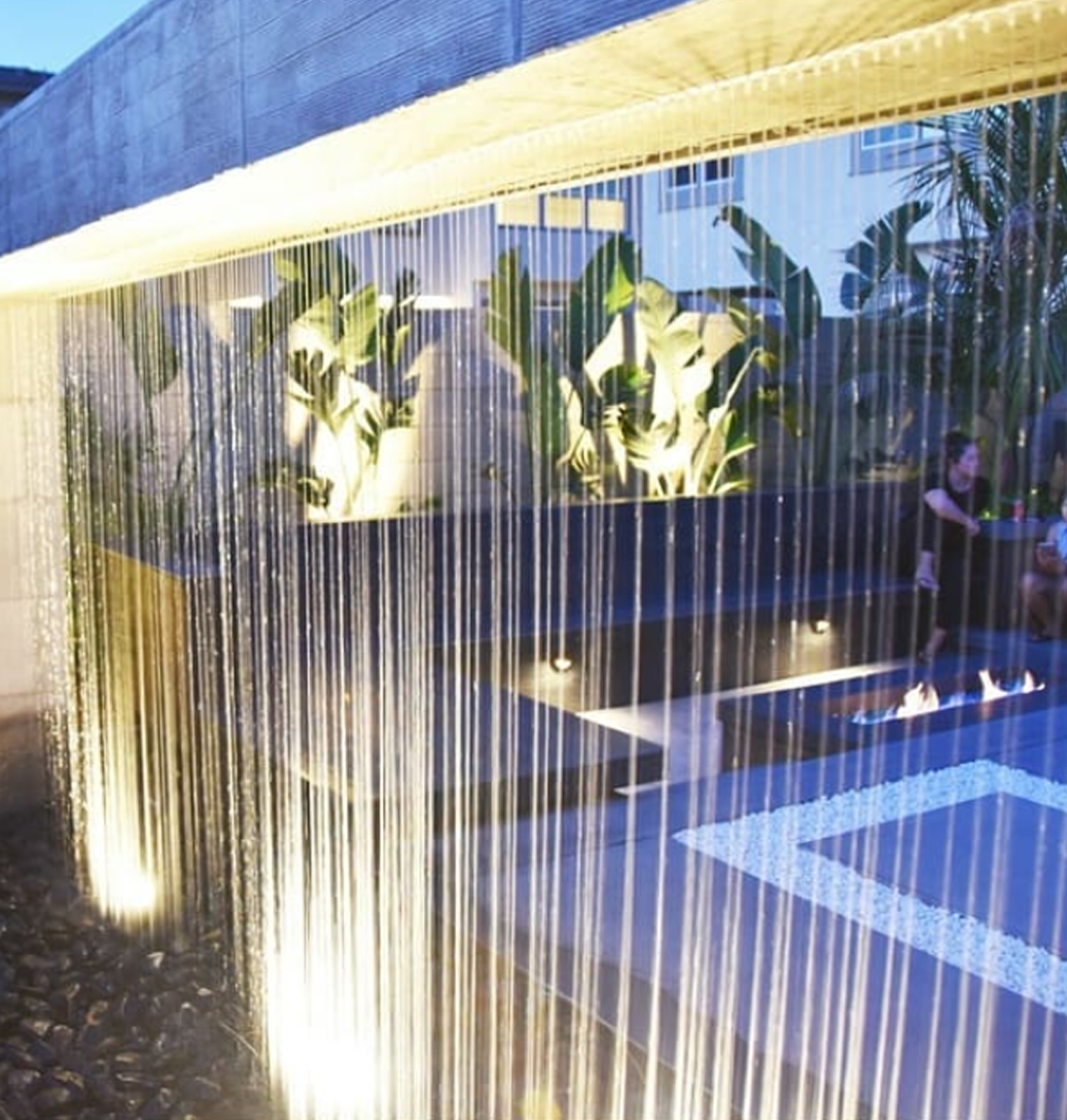
Rain curtains and sheet flow features
Smaller features (up to 48″ wide): 1,000 – 1,200 GPH — light to medium flow
Mid-size features (48″ – 72″ wide): 1,200 – 1,600 GPH — medium flow
Larger features (72″ – 96″+ wide): 1,600 – 1,800 GPH — medium to full flow
Taller features (8’+ drop height): scale up accordingly — more head pressure required
High-volume features (mesh walls, weir overflow systems)
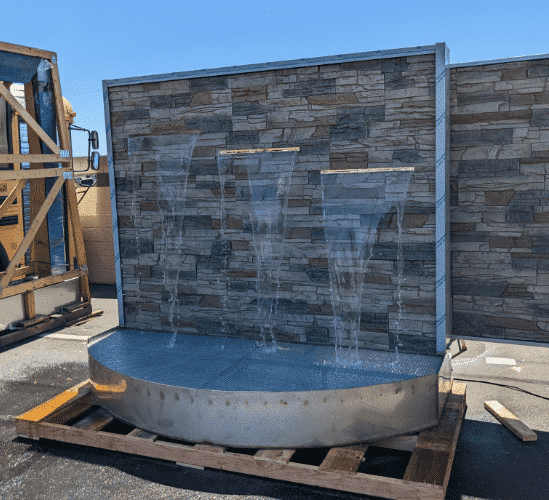
These are a different category entirely. A mesh water wall or weir overflow system is not moving water through nozzles — it’s moving volume across a surface. The GPH requirement goes up dramatically. On a large stainless mesh water wall I built, we started at around 2,000 GPH and ended up near 6,000 GPH through testing and adjustment. There was no formula that got us there — it was a process of running the feature, evaluating the look, and scaling up until the water behaved the way the design required.
Reflection pools with bubblers
Reflection pools are lower flow by design — the goal is calm water with gentle movement, not dramatic sheet flow. Pump selection here is driven more by the number of bubblers and the desired surface disturbance than by raw GPH. A pump with adjustability is particularly useful here since the difference between “subtle ripple” and “too much turbulence” can be a small dial adjustment.
Head height — and why it matters more than most people think
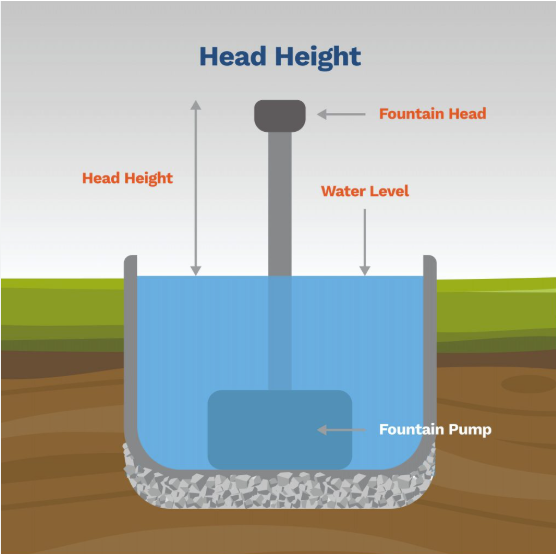
Head height is the vertical distance the pump has to push water — from the water surface in the basin up to the highest point where water is delivered. Every foot of vertical lift reduces the effective GPH your pump can deliver.
Most pump manufacturers publish a performance curve showing GPH at various head heights. A pump rated at 1,800 GPH at zero head might only deliver 1,200 GPH at 8 feet of head. That’s a significant difference, and if you sized your pump based on the zero-head rating without accounting for the actual lift in your installation, you’re going to end up with less flow than you wanted.
The practical takeaway: when you’re selecting a pump for a feature with significant height — anything over 4 or 5 feet of vertical lift — factor in the head height and size up accordingly. When in doubt, go to the next pump size up and dial it back with a ball valve rather than undersizing and having no adjustment room.
Head height rule of thumb: for every 10 feet of vertical lift, expect to lose roughly 20-30% of your rated GPH. Check your specific pump’s performance curve — they vary significantly by pump design.
The ball valve — your most important tuning tool
Here’s something that doesn’t get talked about enough in pump sizing discussions: the right pump for a custom water feature is often one that’s slightly oversized, paired with a ball valve on the outlet line to dial in the flow after installation.
Why? Because the desired look of a water feature is easier to evaluate when water is actually running than it is on paper. A pump with a ball valve gives you a range of adjustment. You run the feature, you look at it, you open or close the valve until it looks right. That’s how experienced installers tune decorative water features.
Some pumps have built-in adjustable flow dials — those are ideal for this application. On pumps without a dial, like the Savio 1200 or EZ Pro 1850, an inline ball valve on the outlet does the same job.
⚠ Important: if you’re using a ball valve to reduce flow, don’t restrict it beyond 50% of full open. Restricting flow too aggressively on a direct drive pump creates back pressure that stresses the motor and shortens pump life significantly. If you find yourself closing the valve more than halfway to get the look you want, you’ve oversized the pump — go down a size.
Nozzle spacing on rain curtains
For pipe-and-nozzle rain curtains specifically, nozzle spacing affects flow distribution across the curtain width — not the total GPH requirement so much as how evenly that GPH gets distributed.
I use 3/4″ nozzle spacing as my standard. It’s not a formula-derived number — it’s a practical decision based on experience. Half-inch spacing produces a very dense, close curtain. Three-quarter inch gives a slightly more open look while still producing a clean, consistent sheet. It also gave me a little adjustment room when clients wanted something tighter — I had a smaller increment to go to rather than having already started at the minimum.
The main thing to understand about nozzle spacing is that it’s a distribution decision, not a flow rate decision. Your GPH is determined by the feature size and desired look. Your nozzle spacing determines how that flow gets spread across the curtain width.
The practical checklist before you call a pump supplier
When I call my pump supplier with a new feature, here’s what I have ready. If you have these answers, the conversation is productive. If you don’t, you’ll be guessing.
- Feature type: rain curtain, reflection pool, mesh wall, or faux stone
- Overall width: of the feature at the water delivery point
- Height: vertical drop from delivery point to basin surface
- Number of outlets: nozzles, bubblers, or overflow points
- Desired look: light/subtle, medium, or heavy/dramatic flow — be specific
- Installation head height: vertical distance from pump to highest delivery point
- Pipe run length: approximate horizontal distance the pump has to push water
With those inputs, a good pump supplier can get you into the right range. The final tuning still happens on site — but you’re starting from an informed position rather than a guess.
The short version
There is no single formula that spits out the perfect pump for a custom decorative water feature. Anyone telling you otherwise is oversimplifying. What exists is a combination of informed starting points, head height math, and on-site adjustment — and that’s how experienced fabricators and installers have always done it.
Start with the look you want. Let that drive the feature size. Let the feature size and head height drive the pump selection. Install a ball valve and tune from there. That’s the process.
If you’re sizing a pump for one of our rain curtain kits or a custom feature you’re planning, feel free to reach out directly. It’s a five-minute conversation and I’d rather talk it through with you than have you end up with a pump that doesn’t perform the way you want.
Questions about pump sizing for a specific project? I’m happy to talk through it before you buy anything.
Reach out at fountainmetalworks.com or call (928) 274-2697.
Schedule a consultation here.
Fountain Metalworks fabricates custom rain curtains, reflection pools, stainless basins, and Corten water features for landscape architects and contractors nationwide. Built in Tucson, Arizona. Shipped to your site.